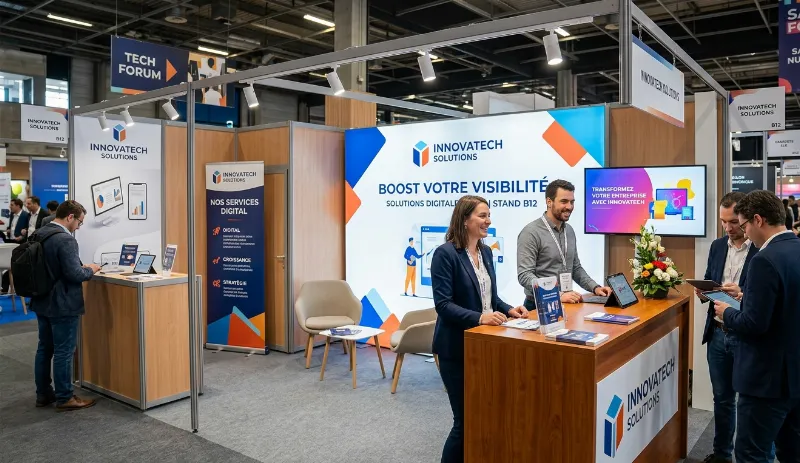
A well-designed stand can triple the number of qualified leads generated during a trade show.
Whether you're exhibiting at the Abidjan Exhibition Center, SARA, ARCHIBAT, or any other West African trade show, this guide walks you through step by step how to transform your exhibition space into a genuine conversion lever. You'll discover the techniques used by leading brands and the mistakes to absolutely avoid.
1. Define precise objectives before any design work
Before discussing design, furniture, or lighting, ask yourself the essential question: why are you exhibiting?
The possible answers will shape the entire project:
- Generate qualified leads for your sales force
- Launch a new product or service on the Ivorian market
- Strengthen brand awareness within a B2B audience
- Build loyalty with existing clients and consolidate relationships
- Recruit distributors or partners across West Africa
- Demonstrate your expertise versus the competition
Each objective implies a different layout. A stand designed for lead generation will prioritize comfortable discussion zones and interactive terminals to capture contact details. A product launch stand will emphasize a spectacular showcase of the flagship product, with ongoing demonstrations.
Practical tip: set yourself 2 to 3 measurable KPIs (number of contacts, product demos, quotes issued) to evaluate the ROI of your trade show participation.
2. Structure the space into functional zones
A successful professional stand is made up of 5 to 6 distinct zones, each serving a specific purpose. This structure is the backbone of effective design.
The essential stand zones
- Welcome zone: a visible counter at the entrance, staffed by one or two hosts trained to qualify visitors in 30 seconds
- Product display zone: a central space showcasing your offer with dedicated lighting and clear signage
- Demonstration zone: ideal for technical products, allowing you to prove the benefits of your solution live
- Discussion zone: a lounge with armchairs or high tables for calm exchanges with serious prospects
- Closed storage zone: a discreet area for brochures, giveaways, personal belongings, and demo stock
- Digital zone: large screen, touch terminal, QR codes to your landing page to capture leads
Golden rule: on a 12 sqm stand (standard configuration at the Abidjan Exhibition Center), plan at least 3 zones. On 24 sqm or more, all 6 zones become indispensable.
3. Refine visual identity and graphic impact
At a trade show, a visitor decides in less than 5 seconds whether to stop at your stand or keep walking. Your visual identity is therefore your first conversion weapon.
The graphic elements to master
- Consistent color palette aligned with your brand, applied to panels, furniture, and textiles
- Main message readable from 5 meters away: a clear promise in 5 to 8 words maximum
- Logo visible from every aisle thanks to elevated signage
- High-quality visuals: large-format digital printing on dibond, forex, or stretched fabric
- Backlit panels for a premium effect and optimal readability even in low light
- Complete wrapping from floor to ceiling for full immersion in your universe
Common mistake to avoid: saturating the stand with too much text. The visitor should understand your business at a glance, not read a brochure hanging on the wall.
4. Optimize visitor flow and accessibility
A closed stand drives visitors away. An open stand invites them in. Your design must encourage intuitive and progressive circulation.
The circulation principles to apply
- Position the welcome counter facing the main entrance to immediately capture the flow
- Avoid tall partitions that block the view and create a psychological barrier
- Create a logical path: welcome → display → demonstration → discussion → exit
- Keep interior aisles clear at a minimum width of 80 cm
- Plan a wide entrance (minimum 1.5 m) to avoid the "funnel" effect
- Consider accessibility for people with reduced mobility
Expert tip: study the trade show floor plan before finalizing your layout. A corner stand requires an opening on two sides. A stand against a wall can concentrate its strengths on the main façade.
5. Choose the right furniture and lighting
Furniture and lighting account for 30 to 40% of a stand's visual impact. Don't overlook them.
Essential furniture
- Customized welcome counter (with your logo and phone charging)
- High tables and stools for informal exchanges
- Comfortable armchairs for in-depth discussions
- Product displays at eye level
- Plexi brochure holders for your printed materials
- Discreet storage (locked cabinets)
Lighting, often underestimated
A poorly lit stand looks dull, even with a perfect design. Plan for:
- Powerful general lighting for overall brightness
- Directional LED spots to highlight your flagship products
- LED strips integrated into counters and displays for a premium effect
- Backlit panels for your key visuals
- A consistent color temperature (warm white for warmth, neutral white for technical feel)
6. Integrate animations and digital elements
A static stand bores visitors. An animated stand captures attention and extends dwell time, directly increasing conversion opportunities.
Effective animation ideas:
- Live product demonstrations every 30 minutes
- Contest with contact collection
- Tasting or personalized giveaways
- Virtual or augmented reality for technical products
- Photobooth with a green wall or signature backdrop
- Mini-conferences or 10-minute pitches
Essential digital layer:
- Tablet for lead collection directly into your CRM
- QR codes to a dedicated trade show landing page
- TV screen displaying your corporate videos
- Free Wi-Fi for visitors in exchange for their email
Summary table: essentials by stand size
Element9 sqm stand18 sqm stand36 sqm and aboveWelcome counter1 (compact)1 (central)1 large + 1 secondaryDiscussion zoneHigh tableArmchairs + coffee tableFull closed loungeDemo zoneOptionalRecommendedEssentialTV screen1 (43 inches)1 (55 inches)2 or moreLighting4-6 LED spots8-12 spots + stripsScenographic lightingClosed storageBuilt-in cabinet2 sqm room4 sqm room + officeDedicated staff2 people3-4 people5-8 people
7. Prepare and train your field team
A perfectly designed stand fails if the team isn't ready. Your staff are the last link in the visitor experience.
Skills to develop before the show:
- 30-second welcome pitch, clear and engaging
- Rapid prospect qualification techniques (BANT, MEDDIC)
- Mastery of product demonstrations
- Use of the lead capture tool
- Dress code and attitude aligned with your brand image
- Handling tough questions and curious competitors
Rotation and breaks: plan shifts every 3 to 4 hours. A tired sales representative converts fewer prospects. Maintaining an energetic, welcoming presence is draining, especially on 3 to 5 day shows like SARA.
To go further, read our article on renting vs. buying an exhibition stand in Abidjan and our guide on design trends for custom stands.
8. Anticipate logistics and setup
Design doesn't stop at the layout. The logistics and setup phase determines whether your stand will be ready on time.
Essential logistics checklist:
- Validation of the floor plan by the show organizer
- Compliance with technical constraints (maximum height, floor load, electrical standards)
- Advance booking of electricity and Wi-Fi with the organizer
- Setup schedule with your stand builder (generally D-2 or D-1)
- Inventory of elements delivered on site
- Testing of lighting and screens the day before opening
- Backup plan in case of breakdown (spare bulbs, adapters, cables)
Abidjan Exhibition Center specifics: setup time slots are strict. Allow a safety margin of 4 to 6 hours before the official opening.
Conclusion: a successful stand is a strategic stand
Successful exhibition stand design is no accident. It's the result of a methodical approach combining strategy, design, logistics, and training.
The 5 key points to remember:
- Define your objectives before any design work
- Structure the space into clear functional zones
- Invest in strong visual design and readable signage
- Streamline visitor flow and refine lighting
- Prepare your team as rigorously as your stand
Preparing your next trade show in Abidjan or West Africa? Request your free quote from Monstand Africa: our designers and our local workshop in Abidjan create your turnkey stand, with a free 3D rendering and end-to-end support.
FAQ
How long does it take to prepare an exhibition stand design?
For a standard stand of 9 to 18 sqm, allow 6 to 8 weeks between the initial brief and on-site installation. For a more complex custom stand (24 sqm or more with a mezzanine, closed room, or sophisticated scenography), allow 10 to 12 weeks. This timeline includes the 3D design phase, client approvals, workshop production, and setup. Start your project as soon as the trade show date is confirmed to avoid costly emergencies.
What's the average budget for exhibition stand design in Abidjan?
Budgets vary depending on size, materials, and customization level. As a benchmark, a turnkey 9 sqm modular stand starts around 1.5 to 2.5 million FCFA, while a custom 18 sqm stand typically ranges between 4 and 8 million FCFA. Premium projects with a mezzanine or scenography frequently exceed 15 million FCFA. A detailed quote from a local stand builder remains the best way to get a precise estimate.
Is it better to rent or buy an exhibition stand?
The answer depends on how often you attend trade shows. If you exhibit once or twice a year, renting a modular stand is often the more rational choice. If you participate in three or more shows per year, buying a reusable custom stand becomes profitable within 2 to 3 years. A reliable stand builder can also store your stand between events and re-skin it for each new show.