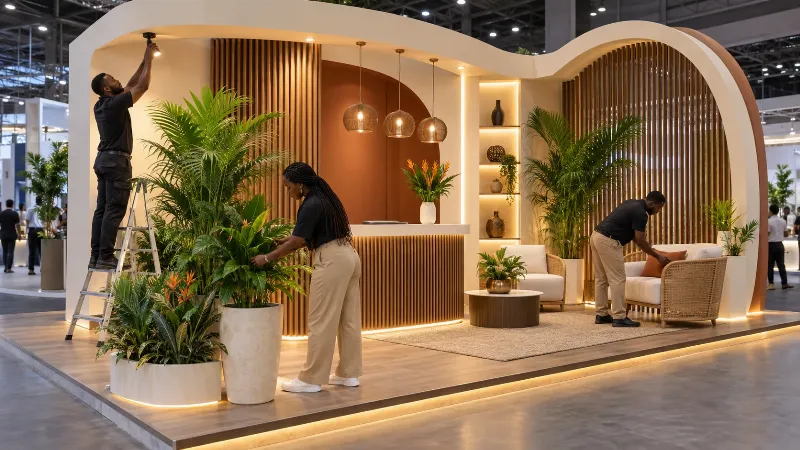
In Côte d'Ivoire, having your stand built locally is usually cheaper than importing one, once you add up freight, customs duties, the 18 % VAT and port handling charges. On top of that come two advantages importing simply cannot deliver: the ability to change your design until a few days before build-up, and a contact physically present at the show if something goes wrong. This article gives you the costed comparison, the cases where importing still makes sense, and a practical checklist for choosing your stand decoration contractor.
What an exhibition stand contractor actually does
Many companies confuse three different trades. That confusion becomes expensive the moment quotes are compared.
- The structure rental company supplies partitions, profiles and standard furniture. It gives you a container, not a brand experience.
- The design or communications agency creates a visual, an identity, an atmosphere. It then subcontracts production.
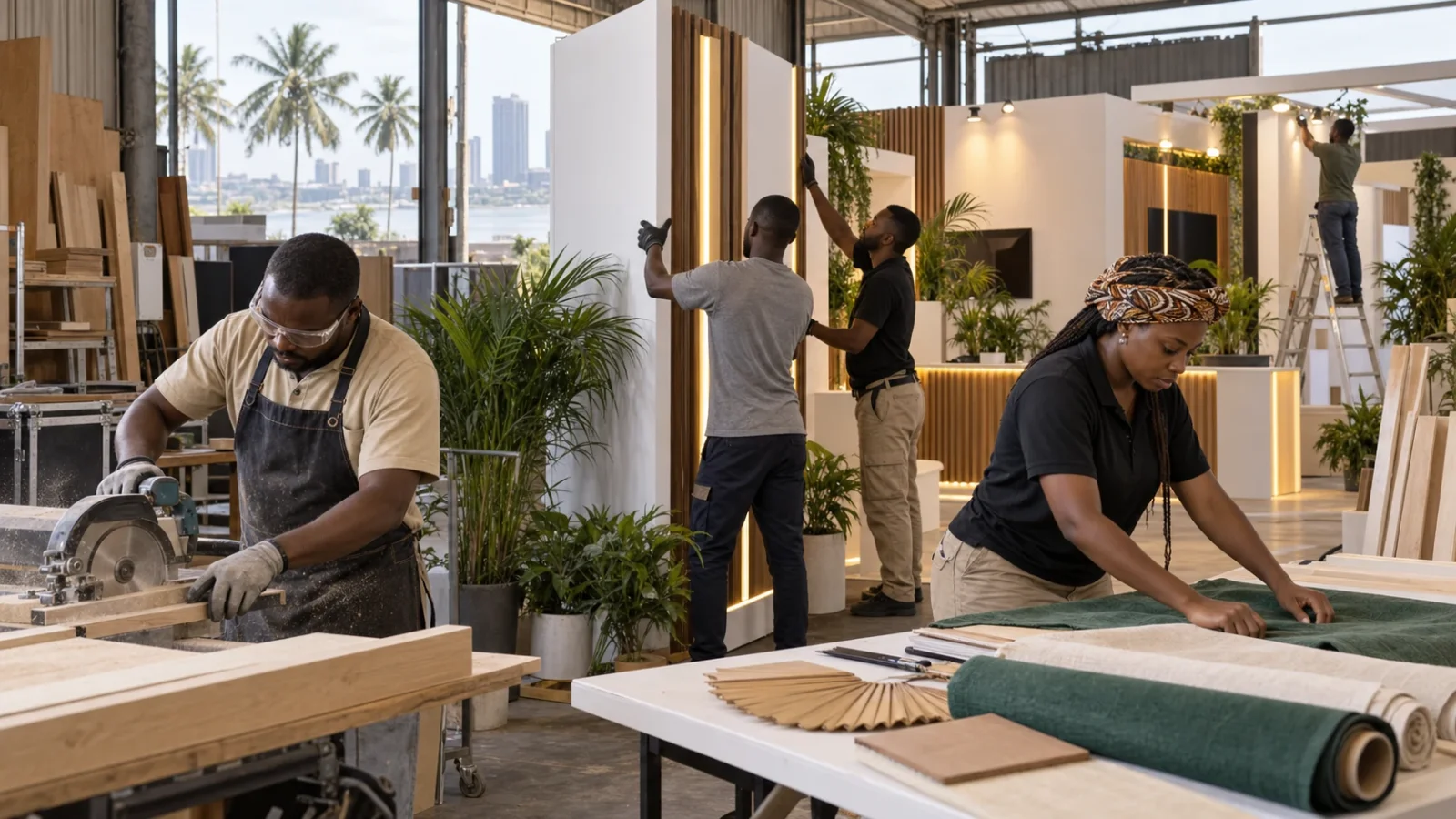
- The stand builder, also called an exhibition stand contractor in Côte d'Ivoire, does both. It designs, produces 3D renders, builds in its own workshop, transports, installs on site, staffs a technical presence during the show and dismantles afterwards.
This distinction determines your risk exposure. With an integrated contractor, one company owns the result. With a chain of subcontractors, every delay cascades and every defect is passed down the line.
On the Ivorian market, most projects revolve around the Abidjan Exhibition Centre (Parc des Expositions d'Abidjan), home to the country's major professional events: SIREXE, ARCHIBAT, SARA, EXPOCIV and SIBAT. The site constraints (permitted heights, truck access, build-up slots, space fees) are second nature to local operators. A foreign supplier discovers them on arrival.
The real cost of an imported stand in Côte d'Ivoire
This is the blind spot in most comparisons. The price quoted by a foreign supplier is never the price delivered to the show floor.
Import taxation
Côte d'Ivoire applies the ECOWAS Common External Tariff (CET). The tariff has five bands: 0 % for essential social goods, 5 % for basic necessities and inputs, 10 % for intermediate goods and inputs, 20 % for final consumer goods, and 35 % for specific goods requiring protection.
Several levies sit on top of that duty. According to the Ivorian Customs administration, the Statistical Fee and the ECOWAS Community Levy are set at 1 % and 0.5 % respectively, while the WAEMU Community Solidarity Levy and the African Union Levy apply at 0.8 % and 0.2 %. An 18 % VAT is then calculated on the customs value increased by the duties.
In budget terms: an imported stand build frequently lands 30 % to 45 % above its original invoice, before you have even paid the freight forwarder, port handling and inland transport to the exhibition centre.
Point of caution: the exact tariff classification of a stand build depends on the materials declared (panels, aluminium structures, printed textiles, furniture). Have your freight forwarder confirm the tariff heading before you decide. The rates above describe the general framework, not a customs quotation.
The invisible costs
None of these appear on a quote. All of them land.
- Sea freight and port dwell time. A container from Europe or Asia needs several weeks in transit, plus clearance time at the Port of Abidjan.
- Forwarding and clearance fees. Forwarder charges, storage if collection drags on, file handling costs.
- The risk of being held. One missing document immobilises the shipment. Five days before doors open, that risk is no longer insurable.
- Damage in transit. A printed panel damaged at sea cannot be repaired locally if it was not produced locally.
- Installation. Either you fly in a foreign crew with flights, visas and accommodation, or you hire a local crew that is discovering the build system for the first time.
The opportunity cost
An imported stand has to be signed off months ahead. Any later change becomes impossible: a new product to showcase, a revised tagline, a co-exhibitor joining, a partner logo added at the last minute. You exhibit with the message you had four months ago.
Six decisive advantages of building locally
1. A readable budget with no surprises
A stand built in Abidjan is invoiced in FCFA, with no currency exposure, no customs line and no port charges. The quote you sign is the amount you pay. For a marketing director who has to protect a budget approved in committee, that is often the deciding argument.
2. Lead times that match how shows actually work
A locally produced build takes weeks, not months. That changes the nature of your planning: you are no longer governed by a shipping date but by an install date, which is far closer and far more flexible.
3. Late changes become possible
This is the most underrated advantage. A graphic reprinted in 48 hours, a counter added, signage corrected: all of it is feasible when the workshop is thirty minutes from the venue. It is structurally impossible with a container at sea.
4. Technical support during the show
At a trade show, incidents are the norm, not the exception: a spotlight fails, a storeroom door jams, an adhesive lifts under the air conditioning. A local contractor is there within the hour. A foreign supplier sends you an email.
5. Reuse from one year to the next
A locally built stand stays in the country. It is stored, refurbished and reconfigured for the next show. Across three participations, that amortisation logic cuts the cost per event dramatically, whereas an imported build is often abandoned or re-exported at a loss.
6. Compliance with venue constraints
Maximum height, floor loading, fire safety rules, vehicle access, build-up slots imposed by the organiser: these rules vary from show to show. An Ivorian stand builder knows them from experience and designs accordingly from the 3D stage onwards.
Comparison table: local fabrication versus importing
| Criterion | Local fabrication in Abidjan | Imported stand |
|---|---|---|
| Total delivered cost | The quoted price, in FCFA | Factory price + freight + duties + 18 % VAT + clearance |
| Import duties and taxes | None | ECOWAS CET (0 to 35 %) + Statistical Fee 1 % + ECOWAS Levy 0.5 % + WAEMU Levy 0.8 % + AU Levy 0.2 % + VAT 18 % |
| Production lead time | A few weeks | Several months, sea transit included |
| Late modification | Possible until a few days before build-up | Impossible once shipped |
| Logistics blocking risk | Low | Real (customs, port, documentation) |
| Support during the show | Crew present on site | Hard to organise |
| Reuse the following year | Local storage and reconfiguration | Expensive, often abandoned |
| Carbon footprint | Reduced | High (long-haul freight) |
| Local content and Ivorian jobs | Strong | None |
When importing is still the right call
It would be dishonest to claim local fabrication wins one hundred percent of the time. Three situations make it less obvious.
- A global group with a unified worldwide stand system. When head office mandates a proprietary system deployed across twenty shows a year, consistency wins and the build travels.
- Specific technical equipment. Certain high-definition LED walls, demonstration machinery or stage lighting are not available locally and must be imported.
- A multi-country tour. The same stand shown in Abidjan, Dakar and Accra within a single quarter can justify a demountable system moved from stop to stop.
In all three cases, the most effective answer is hybrid: the structure or the equipment travels, and all the decoration (wall graphics, visuals, furniture, signage, storeroom) is produced locally. You keep brand consistency without absorbing the full cost and lead time of importing.
How to choose your exhibition stand contractor in Côte d'Ivoire
Seven questions to ask before signing
- Do you build in-house? Ask to visit the workshop. A contractor who subcontracts everything controls neither its lead times nor its quality.
- Is the quote complete? Check that 3D design, fabrication, transport, installation, on-site technical cover and dismantling are all listed. A low price often hides three missing lines.
- How many 3D renders before sign-off? You should see your stand before paying for it, from several angles and on full uncropped boards.
- Which materials exactly? Dibond, Forex, MDF, aluminium: each has a different cost, lifespan and finish. Insist on specifics.
- Who will be at the show? Name, number, hours of cover. A serious contractor gives you this in writing.
- What references on comparable shows? Ask for projects delivered at the Abidjan Exhibition Centre, not just a generic portfolio.
- What happens to the stand afterwards? Storage, refurbishment, reuse: this is a negotiable line that changes your three-year cost.
The countdown schedule to respect
Here is the sequence that works for an Ivorian trade show, counting back from opening day.
- D minus 90: select your contractor, book the space with the organiser, frame the budget.
- D minus 60: sign off the 3D concept and the floor plan.
- D minus 45: sign off visuals, copy and brand guidelines applied to the build.
- D minus 30: fabrication starts in the workshop.
- D minus 7: logistics preparation, quality control in the workshop, technical file submitted to the organiser.
- D minus 2 to D minus 1: installation on site within the allocated slot.
A project launched at D minus 30 is still achievable with a local contractor. The same project by import is already lost.
Our approach at Monstand
We have been designing and building in Abidjan since 2021, for exhibitors such as Epson, Huawei, Sika and Syngenta, across the main Ivorian trade shows. Depending on your budget and your requirements, you can start from a modular base that deploys quickly or go fully custom.
To go further:
- see our stand packages and finish levels to position your budget;
- explore our modular solutions reusable from show to show if you exhibit several times a year;
- review our design, fabrication and installation services to understand what a full turnkey package covers;
- browse our other articles on preparing for West African trade shows for more on scheduling and material choices.
Conclusion
The choice between local fabrication and importing comes down to four measurable criteria:
- Real delivered cost, once duties, VAT and logistics are factored in.
- Lead time, fixed when importing, manageable when building locally.
- Flexibility, since only local production allows late changes.
- Service during the show, which matters the day something fails.
For the vast majority of exhibitors in Côte d'Ivoire, local fabrication wins. Send us your stand dimensions and the show you are attending: you get a costed proposal and a first 3D render free of charge. Write to us through the contact form or on WhatsApp at +225 07 20 26 16 53.
Frequently asked questions
How much does a stand built in Côte d'Ivoire cost?
The budget depends on floor area, stand type (in-line, corner, island) and finish level. A small modular stand and a 36 sqm custom island are not in the same range. The only reliable figure starts from your floor plan and your actual requirements.
How long does it take to have a stand built in Abidjan?
Allow 6 to 8 weeks between concept sign-off and installation. Shorter lead times remain possible on modular bases, with trade-offs on finishes.
Can a stand be reused from one show to the next?
Yes, and it is one of the strongest arguments for building locally. Structures are stored, refurbished and reconfigured to fit the next show's floor area. Only the printed graphics need reproducing.
Do I pay customs duty on imported stand furniture?
Yes, as soon as the goods enter the territory. The rate depends on the tariff heading applied under the ECOWAS CET, plus the community levies and VAT. Have a freight forwarder validate the classification before committing the spend.