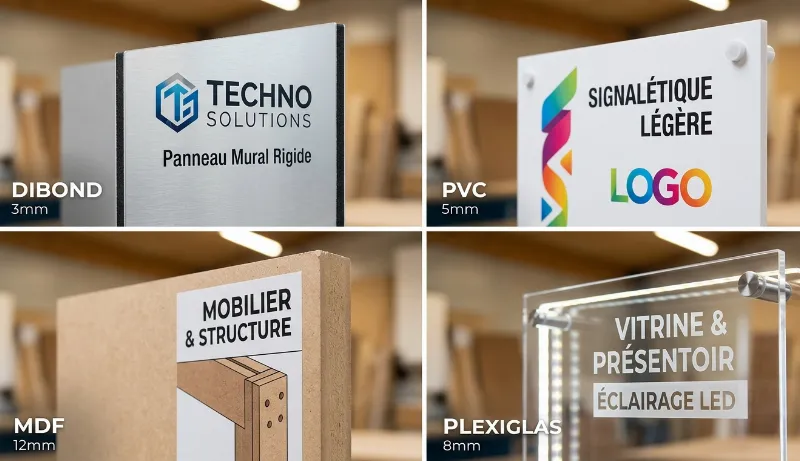
The choice of trade show stand materials is invisible to the visitor, but it decides almost everything behind the scenes: the lifespan of your investment, the visual rendering under the lighting of the Parc des Expositions d'Abidjan, transport costs, the ability to reuse the stand across multiple shows. Yet when a stand builder talks about dibond for the sign, forex for the graphics or MDF for the counter, many exhibitors accept without really understanding.
This article gives you the complete reading grid: what each material is, which element it is meant for, how much it costs, what its limits are. You will be able to read a Monstand quote like an expert and arbitrate every technical trade-off in your next stand.
Why material choice is strategic
On an 18 m² stand, the same element (a 3-metre by 2.5-metre signature wall) can cost anywhere from one to three times more depending on the material chosen. But price is only the visible part. Three issues justify real attention:
- Useful lifespan: a forex panel indoors lasts 5 years without flinching; outdoors under the Ivorian sun, it yellows in 18 months.
- Logistics: a 3 m² MDF wall weighs 25 kg; the same wall in dibond weighs less than 10 kg. On a stand transported between Abidjan, Lomé and Dakar, the weight difference changes everything.
- Visual rendering: under the powerful LEDs of a trade show, dibond reflects a metallic shine that enhances a premium brand, where forex gives a flatter, more economical look.
Understanding these materials is not a technical detail. It is the trade-off that decides whether your stand ages well or not.
Dibond: aluminium composite for premium elements
What is dibond?
Dibond is a composite panel made of two thin layers of aluminium framing a polyethylene core. This sandwich structure gives it exceptional rigidity for a contained weight. Standard thicknesses are 2 mm, 3 mm and 4 mm.
Key properties
- Maximum resistance to weather and UV
- Perfect dimensional stability (it does not expand or warp)
- Brushed, matt or glossy metallic finish depending on the option
- Lifespan of 10 years and more, indoors or outdoors
- Excellent printing surface for high-end graphics
Which stand elements?
Dibond is the reference material for anything that must last and impress:
- Main signage and hanging logos
- Signature walls on premium stands
- Counter façades for a high-end finish
- Communication plates reused from one show to the next
- Outdoor elements (orientation signage outside the hall)
Limits and price
Dibond is the most expensive of the four materials. Expect about three to four times the price of a forex of equivalent thickness. Cutting it requires specific tooling (CNC milling for complex shapes). It is a relevant investment only for elements that justify the long lifespan.
Forex: the versatile expanded PVC
What is forex?
Forex (trade name for expanded PVC) is a rigid foam panel of polyvinyl chloride with closed cells. It comes in thicknesses of 1, 3, 5, 8 and 10 mm. It combines lightness, medium rigidity and excellent value for money.
Key properties
- Very light (density around 0.5 to 0.7 g/cm³)
- Easy to cut, mill and drill
- Excellent printing support (screen printing, UV inkjet)
- Resistant to indoor humidity and moderate variations
- M1 fire-rated indoors for compliant versions
Which stand elements?
Forex is the most widely used material in stands, because it suits almost everything indoors:
- Graphic panels dressing the partitions
- Decorative dividers between stand zones
- Internal signage (totems, rigid banners, zone indicators)
- Counter cladding in economical versions
- Decorative cut-outs (logos, shapes, three-dimensional lettering)
- Light product displays
Limits and price
Forex remains an indoor product. Outdoors and permanently exposed, it yellows under UV and its edges can turn greenish with prolonged humidity. For a stand exposed to open air or near an exposed area, switch to dibond.
On budget, forex is three to four times cheaper than dibond at equivalent surface. It is the material of the smart compromise for the majority of graphic elements on a stand.
MDF: rigid structure for furniture and volumes
What is MDF?
MDF (Medium Density Fiberboard) is a wood-derived panel made of compressed wood fibres with a binder. Uniform density, smooth surface, perfectly suited to painting, lacquering and veneering. Common thicknesses in stand building are 6, 10, 15, 19 and 22 mm.
Key properties
- High structural rigidity
- Perfectly smooth surface for painted or lacquered finishes
- Excellent machining tolerance (grooves, milling, complex shapes)
- Available in water-resistant and fire-rated versions
- Widely available in Côte d'Ivoire through local channels
Which stand elements?
MDF is the material of structural elements and furniture:
- Reception counters and bars
- Product displays with integrated storage
- Low display cases and podiums
- Solid partitions with painted or lacquered finish
- Built-in furniture (shelves, niches, racks)
- Signature wall bases then dressed in dibond or forex
Limits and price
MDF is heavy, its main logistical constraint. A 1.5-metre MDF counter can weigh 35 to 50 kg depending on thickness, complicating transport across multiple shows. It is also sensitive to prolonged humidity if not properly sealed: in Abidjan's humid climate, always favour water-resistant versions for pieces stored between shows.
On price, raw MDF is very affordable. The final cost depends mostly on finishes (paint, lacquer, wood veneer, laminate) which can multiply the investment by two or three.
PVC: the economical material for temporary elements
What is PVC (and the nuance with forex)?
A common confusion: forex itself is an expanded PVC. But in the stand-building language, when we simply say "PVC", we usually mean two different families:
- Solid rigid PVC (in sheets) for cut elements
- Honeycomb PVC (Akylux type), made of two plastic faces separated by cells, ultra-light and economical
Key properties
- Most economical of the four materials
- Very light, easy to handle
- Good printing surface
- Suited to short uses (single show or a few days)
- Recyclable through the relevant channels
Which stand elements?
PVC suits temporary or disposable elements:
- Promotional panels for one-off campaigns (show offer, product announcement)
- Short-term signage (event orientation)
- Light point-of-sale displays distributed or shown for a single event
- Test elements before validating a final design
Limits and price
Honeycomb PVC lacks rigidity beyond certain sizes. It warps easily and does not support repeated use. Its rendering remains flat and not very flattering for a brand that wants to project a premium image.
On budget, it is unbeatable: about half the price of forex at equivalent surface. The right choice when the expected lifespan is less than a month.
Comparison table: the 4 materials at a glance
| Criterion | Dibond | Forex | MDF | Honeycomb PVC |
|---|---|---|---|---|
| Family | Aluminium composite | Expanded PVC | Reconstituted wood | Honeycomb plastic |
| Weight | Light | Very light | Heavy | Very light |
| Rigidity | Excellent | Good | Excellent | Low |
| Lifespan | 10 years and more | 5 to 7 years (indoor) | 5 to 10 years (depending on finish) | A few weeks |
| Indoor use | Excellent | Excellent | Excellent | Good |
| Outdoor use | Excellent | Limited | Not recommended | Not recommended |
| Indicative price | High | Medium | Medium (excluding finishes) | Low |
| Typical element | Sign, signature wall | Graphics, signage | Counter, furniture | One-off display |
How to combine materials for an optimal stand
A well-designed stand never relies on a single material. It intelligently combines the four according to the function of each element. Here is an arbitration logic that works for 90 % of projects:
- Structure and furniture: MDF (with finishes adapted to your brand image)
- Visible graphic elements: forex for most, dibond for signature elements
- High signs and hanging logos: dibond exclusively
- Partitions and backdrops: MDF as base, dressed with forex for the graphics
- One-off displays and short-term signage: honeycomb PVC
This logic optimises the budget without sacrificing image. This is precisely the work of a good stand builder: arbitrating every material-function trade-off. Discover our design and fabrication services that integrate this approach.
Three additional criteria specific to the Ivorian market
In Abidjan, three local factors weigh in the material choice and deserve to be anticipated:
Tropical humid climate
The high ambient humidity weakens some materials between shows. Non-water-resistant MDF can swell, forex can dull. Always favour water-resistant versions and controlled storage conditions with your stand builder.
Local availability
All these materials are available in Abidjan, but with stock variations. MDF is widely present through local channels, allowing short lead times. Dibond and forex are imported but permanently stocked by professional stand builders. Honeycomb PVC is available in large quantities. This local availability makes local fabrication faster than importing ready-to-assemble stands.
Regional logistics
If your stand travels between Abidjan, Dakar, Lagos or Lomé, the weight of materials becomes critical. Favour hybrid solutions: light demountable structure, forex graphic panels (can be rolled), light dibond signature sign.
Common mistakes to avoid
Four mistakes regularly come up in exhibitor briefs in Abidjan:
- Asking for everything in dibond: this is over-investment. Reserve dibond for signature elements.
- Skipping the water-resistant version of MDF: Ivorian climate quickly catches up on this saving.
- Confusing forex and dibond in a quote: the price difference is 3 to 4 times, always check the nomenclature.
- Choosing honeycomb PVC for structural elements: it warps, the stand ages badly from day two.
A serious quote details precisely the material of each element with thickness and finish. Be wary of quotes that only mention "decorative panels" without specifying the nature.
Conclusion
The right material for a trade show stand is chosen element by element, never in bulk. Dibond dominates for signature and premium elements, forex is the universal compromise for graphics, MDF structures furniture and volumes, honeycomb PVC completes the toolkit for one-off needs.
Preparing your next show in Abidjan? Request your personalised Monstand quote: our teams explain every material-function choice and deliver a locally fabricated stand, with the right materials in the right places.
FAQ
Which material is most used for the walls of an exhibition stand? For solid partitions, MDF remains the base material, generally then dressed with forex panels for the graphics. This combination offers the best rigidity-budget-rendering ratio for 90 % of stands.
Is dibond profitable for a stand used only once? No, except for a high-end signature element (main sign, photo wall). For a single-use stand, forex covers almost all graphic needs at three to four times less. Reserve dibond for elements reused across multiple shows.
Which forex thickness should I choose for a graphic stand panel? For an indoor panel fixed to a partition, 3 mm is enough. For a freestanding or large-format panel, switch to 5 mm. The 10 mm thickness is reserved for decorative cut-outs and three-dimensional lettering.