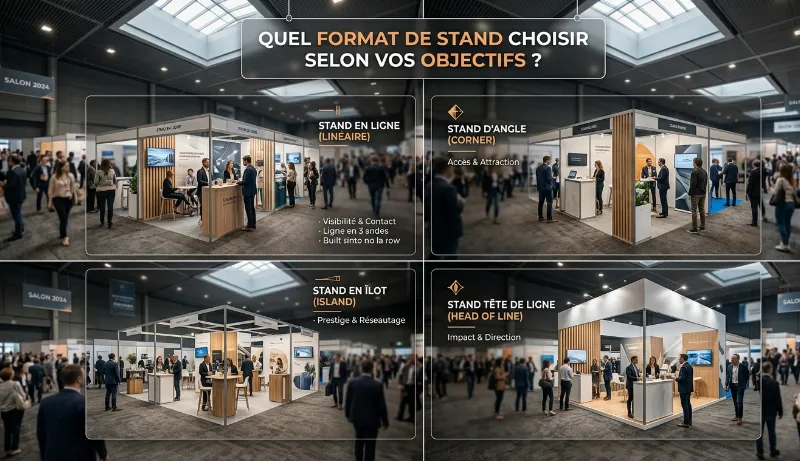
The trade show stand format you book determines 50 % of your show's performance, before design even enters the picture. A well-designed 12 m² inline stand can outperform a poorly used 36 m² island, and vice versa. In Abidjan, where the Parc des Expositions pricing grid varies by configuration, the arbitration between corner, inline, island and end-cap directly impacts your budget and lead generation.
This article breaks down the four stand formats, their strengths, their limits and the exhibitor profile each one is most profitable for. You will know exactly which spot to book for your next SARA, ARCHIBAT or SIREXE.
The four trade show stand formats explained
Before comparing, let's set the definitions. A stand is defined by the number of sides open to an aisle. That number drives visibility, price per square metre and design possibilities.
The inline stand (linear)
A single side open to the aisle. Three sides closed off by partitions shared with neighbouring exhibitors. This is the most common and most affordable trade show stand format. Standard depth is 3 metres, which leaves limited room for layout.
The corner stand
Two open sides forming an angle, two closed sides. Generally located at the intersection of two aisles, at the end of a row. The corner stand offers greater visibility than an inline format for a moderate price premium.
The end-cap stand (or peninsula)
Three open sides, one closed side at the back. Positioned at the end of a row, it offers 270-degree access. This is a premium format reserved for strategic exhibitors.
The island stand
Four open sides. The stand is surrounded by aisles, with no direct neighbours. Maximum visibility, maximum price. The island demands a design centred on a strong focal point (totem, screen, signature product) to structure the space.
Comparison table: the 4 formats at a glance
| Criterion | Inline stand | Corner stand | End-cap stand | Island stand |
|---|---|---|---|---|
| Open sides | 1 | 2 | 3 | 4 |
| Visibility | Low | Good | Very good | Maximum |
| Location premium | Baseline | +10 to 20 % | +25 to 40 % | +40 to 70 % |
| Recommended minimum size | 6 to 12 m² | 9 to 18 m² | 18 to 36 m² | 36 m² and above |
| Façades to dress | 1 | 2 | 3 | 4 |
| Best suited for | SMEs, first participation | Growth, regional visibility | Established brands | Sector leaders |
When to choose an inline stand
The inline stand is the right choice when your main goal is presence, not spectacular demonstration. It fits perfectly with:
- A first participation in a trade show (testing the format before a heavier investment)
- A tight budget with a qualified-leads goal rather than massive brand awareness
- A B2B activity where visitors come to you with clear intent (services, consulting)
- A show where your brand is already well known and you don't need to capture passing traffic
The classic mistake to avoid: placing a counter parallel to the aisle. It creates a visual barrier, the visitor slows down, reads the signage and walks past without entering. Prefer a counter set back from the aisle or perpendicular to open up access.
When to choose a corner stand
The corner stand offers the best visibility-to-price ratio for most exhibitors. Two possible entry points statistically double the chances of catching a visitor moving through the hall.
It is particularly suited to:
- A growth strategy with a quantified lead target
- The launch of a product or range requiring demonstration
- A regional brand looking to consolidate awareness in West Africa
- An intermediate budget that does not justify an island but seeks more than a linear
To make the most of a corner, treat both façades as two distinct entrances, not as one large frontage. Each must independently communicate your brand's main message.
When to choose an end-cap stand
The end-cap is the format of brands that want to dominate an aisle. With three open sides, it combines island-level visibility at an intermediate cost, while keeping a usable back wall for communications, storage or confidential meeting areas.
This format is profitable if:
- You target more than 200 leads from a single show
- You need a confidential meeting space backed against the rear wall
- Your audience includes decision-makers who only stop at stands visible from afar
- You attend one strategic show per year (concentrated-investment logic)
The end-cap requires careful design: three façades to dress, plus a tall visual anchor (totem, hanging sign) to remain identifiable from across the hall.
When to choose an island stand
The island stand is the investment of sector leaders and major groups. Four open sides mean four façades to dress, hence a multiplied fabrication cost, but also four times more opportunities to capture a visitor.
The island is the right call if:
- Your goal is brand awareness more than lead qualification
- You are launching a product with a strong central demonstration
- You host delegations, VIP clients or journalists
- You want to position your brand as the undisputed leader of your sector
A word of caution: a poorly designed island is a costly failure. Without a strong central focal point (tall totem, hanging structure, signature product), the space looks empty and visitors don't know where to head. Scenographic design matters more here than in any other format.
Four criteria to arbitrate your choice
Beyond budget, four criteria should guide your final decision:
- Your main goal: presence, qualified leads, brand awareness or product launch
- Hall density: the denser the show, the more an expanded visibility format (corner, end-cap, island) is justified
- Your on-site team: an empty island is counter-productive; plan one staff member per 10 m²
- Multi-show logic: a modular stand designed to switch between formats (inline → corner → island) spreads the investment across several editions
This is precisely the value of intelligent modular design: the same components can reconfigure a stand from one format to another depending on the booked location. Discover our premium modular solutions built for this logic.
The location tip few exhibitors know
A pattern observed across nearly every trade show: visitors turn right after entering, by road-driving reflex. In practical terms, at equal size and format, a stand located to the right of the main entrance captures 15 to 20 % more traffic than a stand located to the left.
When you negotiate your spot with the organiser, don't just look at the format, look at the position in the hall.
Conclusion
The trade show stand format is chosen by crossing three variables: your goal (presence, leads or awareness), your budget and the show's density. Linear remains relevant to start, corner offers the best visibility-to-price ratio, end-cap suits established brands, island is the choice of leaders.
Preparing your next show in Abidjan? Request your personalised Monstand quote : we help you arbitrate the optimal format and design a stand that makes the most of every open façade.
FAQ
Which stand format offers the best visibility-to-price ratio? The corner stand is generally the best compromise. With two open sides at a 10 to 20 % premium over an inline format, it doubles the chances of catching a passing visitor while keeping the budget under control.
Do you need a large island stand to be visible? No. A well-designed 18 m² corner stand, with a hanging sign and a clear scenography, can be more visible than a poorly used 36 m² island. Design matters as much as format.
Can a modular stand switch between formats from one show to another? Yes, that is one of the major advantages of modular stands: by adding or removing panels, a stand can move from inline to corner, then to island from one show to the next. It is the most profitable solution for exhibitors active across multiple editions per year.