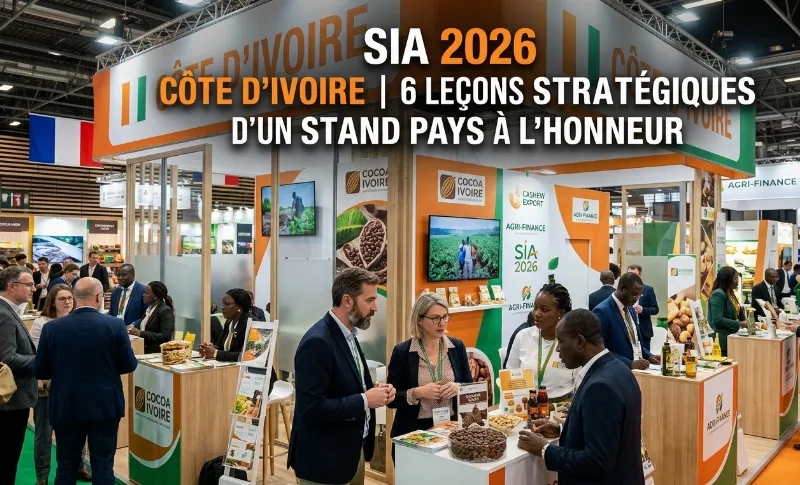
A historic first for West Africa's leading agricultural power, which co-inaugurated the show alongside France in the presence of President Emmanuel Macron. Beyond the diplomatic significance, this oversized participation offers a genuine case study for any company, institution or Ivorian subsidiary planning to exhibit internationally. This article breaks down six concrete lessons that any exhibitor can apply to their next trade show, whether in Abidjan or abroad.
SIA 2026 and Côte d'Ivoire's exceptional positioning
SIA is one of the world's largest agricultural events, drawing over 437,000 visitors and 1,146 exhibitors during this 2026 edition, according to the show's official figures. Being named guest of honor represents an exceptional visibility opportunity: dedicated webpage, reinforced presence in official communications, VIP club access, national flag displayed during and after the event.
For Côte d'Ivoire, the stakes went well beyond agriculture itself. As the world's top producer of cocoa and cashew nuts, the country wanted to position its agriculture as both an economic and diplomatic lever. The official delegation, led by several ministers including those of Agriculture, Animal Resources, and Water and Forestry, used the show to present the second-generation National Agricultural Investment Programme (PNIA 2) and promote the upcoming SARA edition in Abidjan.
The Ivorian pavilion showcased flagship value chains: cocoa, coffee, cashew, rubber, oil palm, tropical fruits. On February 26, 2026, an entire day was dedicated to Côte d'Ivoire, featuring conferences, B2B meetings and live demonstrations.
Here are the six strategic lessons to take away.
Lesson 1: Ambition starts with the size of your stand
A 445 sqm pavilion at the heart of a themed hall is not a logistical detail, it is a political and commercial statement. By comparison, a standard exhibition stand at the Abidjan Exhibition Park typically ranges from 18 to 72 sqm. By multiplying the usual surface tenfold, Côte d'Ivoire instantly signaled that it was not coming as a mere visitor, but as a structural player.
What this teaches Ivorian exhibitors
Stand size is a positioning investment, not a cost to minimize. Three principles worth remembering:
- A generous surface allows you to host multiple visitor flows simultaneously (press, decision-makers, general public), without saturation or bottlenecks
- It lets you multiply experience zones (tasting, demonstration, meetings, VIP lounge), instead of cramming everything into a single space
- It sends a signal of seriousness to institutional partners and media
Before defining your next stand's surface, calibrate it against concrete objectives: how many unique visitors to welcome, how many B2B appointments to organize, how many products or services to showcase. An undersized stand wastes opportunities day after day, while fixed costs (rental, hotel, travel, staff) remain the same.
Lesson 2: A strategic location makes all the difference
The Ivorian pavilion was located in Hall 7.1, the area traditionally dedicated to guest countries and international delegations. This placement is far from accidental: it concentrates professional visitor flows, official meetings and press coverage.
Placement, the first lever of visibility
At a trade show, location can determine up to 70% of spontaneous traffic to your stand, regardless of how well-designed it is. To optimize this parameter, keep three criteria in mind:
- Proximity to main aisles: an end-of-aisle or corner stand naturally receives more visitors
- Thematic environment: being surrounded by complementary players reinforces your sector credibility
- Institutional neighborhood: being close to official stands, press areas or conference halls attracts a higher-value audience
The same rules apply to Abidjan shows like SARA, ARCHIBAT or SIREXE. Book your location as early as possible (ideally six to twelve months ahead) to maximize choice, and don't hesitate to pay a modest premium for better placement, the return-on-investment gap is largely positive.
Lesson 3: Scenography as a storytelling tool
The Ivorian pavilion was not just a product showcase, it was a story. The cocoa, coffee, cashew, rubber, oil palm and tropical fruit value chains were staged to tell a narrative: that of a diversified, high-performing agriculture geared toward food sovereignty.
From product to narrative
An effective stand does not just display, it tells a story. Three scenographic elements that worked particularly well at SIA 2026:
- Display of raw materials in their natural state, anchoring the reality of the field
- Bilingual educational panels explaining the value chain, from producer to international market
- A strong visual identity blending traditional codes with a modern signature, instantly recognizable
For your next stand, ask yourself these questions before tackling design: what is the core message I want to leave after 30 seconds of visit, what emotion am I trying to trigger, what action do I want to prompt (website visit, contact request, signed quote). Scenography without narrative is just decoration. With a narrative, it becomes a commercial tool.
For a deeper dive, see our complete guide to stand design and fitting-out.
Lesson 4: Animation and visitor experience, the keys to memorability
SIA 2026's official figures speak for themselves: 437,402 visitors and 79 official visits across nine days. In such a crowd, what separates a visited stand from a memorized one largely comes down to animation.
Activate your stand, don't let it sit idle
A static stand, however beautiful, sees visitors walk past without stopping. To turn passage into engagement, several levers were activated at the Ivorian pavilion:
- Tastings of flagship products (chocolate, coffee, dried mango, cashew nuts)
- Live agri-food processing demonstrations
- Meetings and signings with ministers, ambassadors and decision-makers
- Themed conferences open to the professional public
- Cultural performances showcasing Ivorian heritage
For a corporate stand, you obviously won't operate at the same scale, but the logic stays identical: plan at least one animation every two to three hours to maintain constant flow. This can take the form of a product demo, a mini-workshop, a quiz with prizes, an expert intervention or a live client testimonial recording.
Investing in animation is generally far more profitable than spending the same budget on one extra square meter.
Lesson 5: Aligning B2B, media and institutional engagement
The Ivorian pavilion did not separate audiences, it made them interact. Across the same 445 sqm, European business leaders, international donors, specialized press and the general public all crossed paths.
Three audiences, one scenography
This mix, far from being a flaw, multiplied opportunities. Here is how to organize it on your own stand:
- An open welcome zone for spontaneous visitors, lively and educational
- A semi-private space for scheduled B2B meetings, with table, screen and relative confidentiality
- A press corner clearly identified, with press kit, high-definition visuals and a dedicated contact
- A central animation point acting as a crossroads between the three zones
This structure lets a single stand serve several objectives at once: generating commercial leads, attracting media coverage, hosting official visits and producing content for your social media.
This is exactly the logic applied by stand builders designing spaces for major accounts like Epson, Huawei, Sika or Africa Re: structuring the visitor journey so that no opportunity goes to waste.
Lesson 6: Return on investment plays out after the show
SIA 2026 closed on March 1, but for the Ivorian delegation, the real work was just beginning. The dedicated page on the show's website, the press coverage, the B2B contacts gathered on site only generate value if they are activated in the following weeks.
Plan the post-show from the design phase
Top-performing exhibitors integrate the post-show into their strategy from day one. Concretely:
- Systematic contact capture through QR codes, scanned badges or connected tablets
- Production of visual content (photos, videos, interviews) to publish on LinkedIn, Instagram and YouTube
- Structured commercial follow-up within 7 to 14 days after the show closes, while contacts are still warm
- Internal reporting with figures: visits, qualified leads, signed contracts, press articles generated
- Reuse of the stand for an upcoming show, to amortize the initial investment
A stand that ends at dismantling is a cost. A stand that feeds your commercial pipeline for the next six months is an investment.
To see how our stands are designed to enable this continuity, browse our modular and reusable solutions.
Summary table of the six SIA 2026 lessons
| Lesson | Key principle | Practical application |
|---|---|---|
| 1. Size | Stand format is a message | Calibrate surface to objectives, not to a minimal budget |
| 2. Location | Placement creates 70% of traffic | Book 6 to 12 months ahead, target corners and main aisles |
| 3. Scenography | A stand tells a story | Define a core message, target emotion, expected action |
| 4. Animation | Engagement beats aesthetics | Plan one animation every 2 to 3 hours |
| 5. Audience mix | Serve B2B, press and institutions together | Structure the stand into complementary zones |
| 6. Post-show | ROI plays out after the event | Capture, follow up, reuse the stand for the next show |
How Monstand Africa applies these lessons on Ivorian ground
None of these lessons are reserved for 445 sqm guest-country pavilions. They apply from as little as 18 sqm at the Abidjan Exhibition Park, provided they are built into the design from the start. A good exhibition stand builder in Abidjan integrates these six dimensions into the creative brief, before drawing the first 3D rendering.
In practice, this means:
- A strategic framing phase with the client to define objectives, audiences, message and overall budget
- An iterative 3D design validated at several stages, to avoid surprises
- Local fabrication in the Abidjan workshop, using premium materials (dibond, forex, MDF, LED lighting, touchscreens)
- Assembly, on-site technical support during the show, and dismantling handled by a dedicated in-house team
- Modular storage of reusable elements for future editions
This is the method that allows both international brands and Ivorian SMEs to access the same level of quality, whether they exhibit in Abidjan, Dakar, Lomé or one day in Paris.
To prepare your next show with a strategic approach, browse our specialized articles and case studies or contact our team directly.
Conclusion
SIA 2026 made Côte d'Ivoire a highly visible player in the global agri-food landscape, not just thanks to product quality, but thanks to staging quality. The six lessons retained, calibrated size, strategic location, narrative scenography, continuous animation, audience mix and post-show activation, are transferable at every level, from country pavilion to SME stand. As every trade show becomes a visibility battle, investing in a stand designed for the long run is no longer optional.
Preparing a trade show in 2026 at the Abidjan Exhibition Park or internationally? Request your personalized quote and benefit from full strategic support, from brief to dismantling.
FAQ: Côte d'Ivoire pavilion at SIA 2026 and high-impact stands
1. What was the size of the Ivorian pavilion at SIA 2026 and where was it located?
Côte d'Ivoire's pavilion at SIA 2026 covered 445 sqm in Hall 7.1 of the Porte de Versailles Exhibition Park in Paris. This location, traditionally dedicated to guest countries, gave it maximum visibility among professional and institutional visitors. The country also benefited from 50 sqm of additional free space, on top of ministerial surfaces (250 sqm for Agriculture, 120 sqm for Animal Resources and 75 sqm for Water and Forestry), distributed across the various value chains being showcased.
2. Which Ivorian companies can draw inspiration from this model for their own stands?
All organizations exhibiting in a B2B context: agricultural value chains, industrial groups, exporting SMEs, public bodies, African subsidiaries of multinationals. The principle remains the same: think of the stand as a positioning tool, not just decoration. The lessons from the Ivorian pavilion apply from as little as 18 sqm at the Abidjan Exhibition Park, as long as size, location, scenography, animation and post-show exploitation are built into the initial brief given to your exhibition stand builder in Abidjan.
3. How much does a premium stand reflecting this level of ambition cost, fabricated locally in Abidjan?
A 36 sqm premium custom-built stand fabricated locally in Abidjan typically costs between 4,500,000 and 9,000,000 FCFA, all-inclusive (3D design, fabrication, high-end materials, LED lighting, screens, furniture, assembly, dismantling). For a 72 sqm stand or larger with animation features, the budget ranges from 8,000,000 to 16,000,000 FCFA depending on the level of finish and animation intensity. Compared to an equivalent imported stand, savings can reach 40%, freeing up budget for animation, communication and lead capture.